
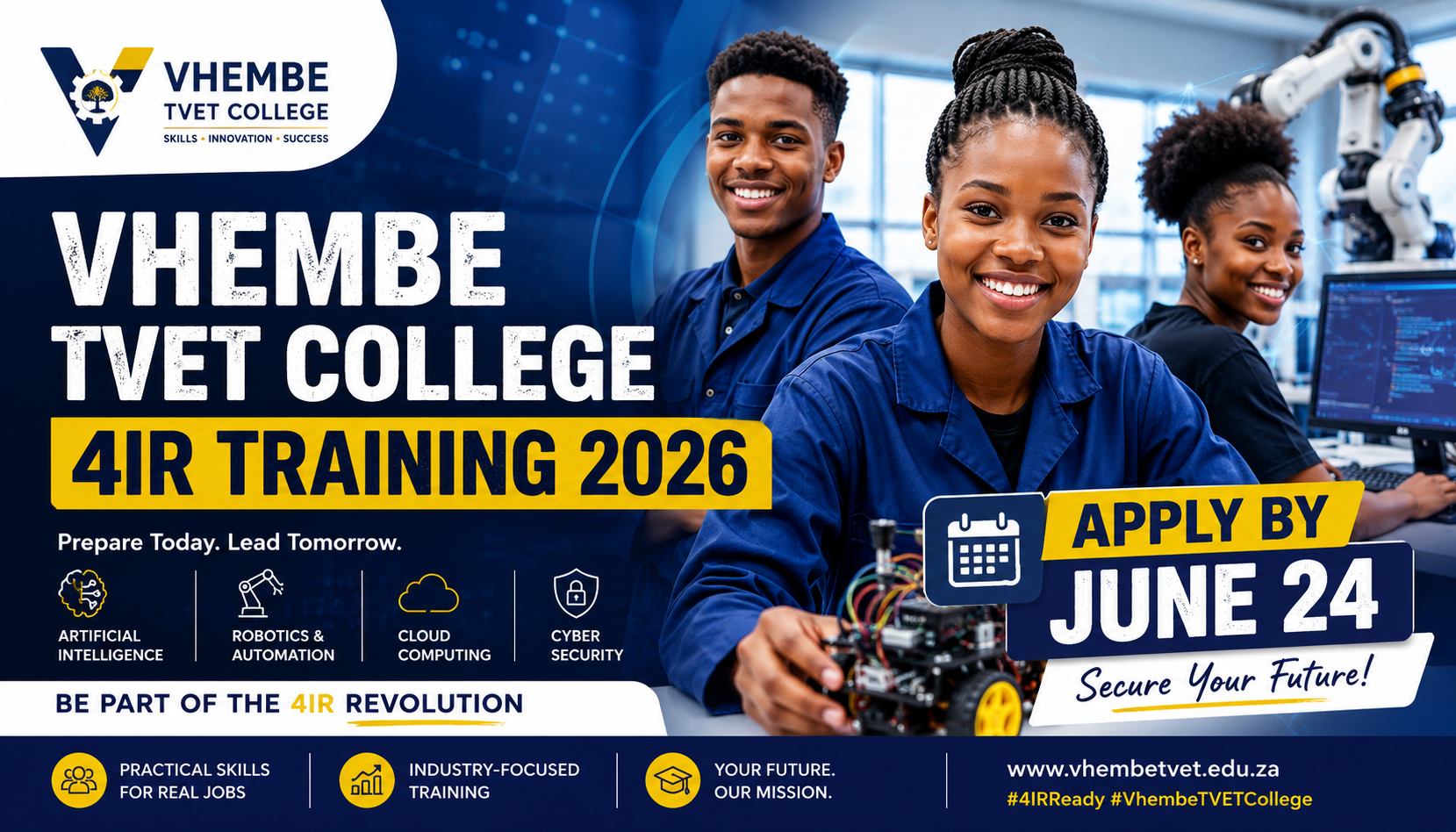

South Africa’s job market is changing fast. Technology is everywhere now – in farms, mines, factories, and logistics. But here’s the problem: there aren’t enough people who actually know how to build, run, and fix these smart systems. If you’ve just finished matric and you’re looking for a real way into the tech world, 4IR training at Vhembe TVET College might be exactly what you need right now.
What Is This Opportunity?
The Fourth Industrial Revolution (4IR) is about robots, smart devices, and machines that work together without much human help. Every day, more companies in South Africa are adopting this technology. Mining companies use automated systems. Farms use sensors to track crops. Factories use robots on assembly lines.
The problem is clear: there’s a huge shortage of young people who actually understand how these systems work. Vhembe TVET College is stepping in to bridge that gap. They’re offering two short, intense 3-month training programmes designed to give you real, hands-on skills that employers actually want.
The college has 100 spots available, split equally between two streams:
- Mechatronics: Learn how robots and automation systems work. You’ll work with sensors, motors, and computer controls.
- Internet of Things (IoT) Developer Training: Learn how smart devices connect and share information. You’ll work with networks and data collection systems.
Key Details:
- Location: Makwarela Campus, Limpopo
- Duration: 3 months, full-time
- Mechatronics Start Date: 1 July 2026
- IoT Developer Start Date: 1 October 2026
- Application Closing Date: 24 June 2026
- Cost: Fully funded (free)
Who Can Apply?
You must meet all of these requirements. Check each one carefully before you apply:
- You passed Grade 12 (matric) or have a higher qualification.
- You studied Mathematics as a subject (Mathematical Literacy does not count).
- You studied Physical Science as a subject.
- You are currently unemployed.
- You are a South African citizen or permanent resident.
- You are genuinely interested in technology and automation.
- You can attend classes at the Makwarela Campus every day for the full 3 months.
- You have an updated CV ready to send.
Be honest with yourself. If you struggled badly with maths or science in high school, or if you hate detail-oriented work, this course will be very difficult. This is not a passive course where you sit and take notes. You’ll be hands-on, building things, and troubleshooting problems constantly.
What Will You Gain?
Real Skills That Employers Want: You won’t learn from textbooks. You’ll work with actual industrial robots, sensors, and control systems. You’ll see the exact machines and technology that are being used in real factories and farms right now.
A Recognized Qualification: The IoT Developer Programme is officially linked to SAQA (ID 119262). This means your certificate is verifiable and recognized by employers across South Africa.
A Major Career Advantage: When you finish, you’ll have skills that very few young South Africans have. You’ll stand out to employers in mining, agriculture, manufacturing, and logistics. You’ll be competing for better jobs, not just any job.
Valuable Connections: You’ll spend 3 months with instructors, peers, and industry experts. These connections often lead to internships, apprenticeships, and job offers.
A Clear Path Forward: This training isn’t a complete career on its own. It’s a bridge. You leave with the foundation to apply for junior technician roles, apprenticeships, or further technical training. It proves to employers that you’re serious about technology and capable of learning complex systems.
How to Apply
The application is simple and done entirely by email. Follow these steps exactly:
- Open your current CV. Make sure your Mathematics and Physical Science grades are clearly visible near the top.
- Add any computer skills, technical hobbies, or short courses you’ve completed.
- Save your CV as a clean PDF (not a Word document).
- Open your email and compose a new message.
- In the subject line, type exactly: 4IR TRAINING 2026
- In the email body, write a short professional note. Say which programme you want (Mechatronics or IoT Developer). For example: “Dear Hiring Team, please find attached my CV for the 4IR TRAINING 2026 programme. I am applying for the Mechatronics stream because I have a strong background in physical science and I’m passionate about automation. Thank you for your time.”
- Attach your PDF CV.
- Double-check the email address for typos.
- Send your application to recruitment@vhembecollege.edu.za before 24 June 2026.
Tips to Improve Your Chances
Only 100 spots are available, and many people will apply. Here’s what makes applications stand out:
Make Your Grades Obvious: The college needs to see your Mathematics and Physical Science results immediately. Don’t bury them in your CV. Put them near the top in your education section. Use bold or highlight them if you need to.
Get the Subject Line Exactly Right: The college uses automated filters to sort emails. If your subject line is wrong, your email might never be opened by a human. Type it exactly: 4IR TRAINING 2026
Send Early, Not Late: Don’t wait until 24 June to apply. Email servers can be slow. Your internet might cut out. Load-shedding might hit. Apply at least a week early so you’re safe.
Write a Professional Email Body: Don’t send a blank email with just an attachment. Write two or three sentences. Say which programme you want. Say briefly why you’re interested. This shows respect and professionalism.
Use a Professional Email Address: If your personal email looks unprofessional, consider creating a new one just for job applications. Something like firstname.lastname@gmail.com works well.
Check Everything Twice: Before you hit send, check your CV for spelling errors. Check the recipient email address. Check your subject line. Mistakes cost you.
Is This Worth Your Time?
Some people worry that a 3-month course isn’t worth committing to. They think they’d rather wait for a year-long learnership or a job with a big stipend.
That thinking costs opportunities. Here’s why this matters: three months of intense, focused training in mechatronics or IoT is worth far more than a year of generic admin work when you’re applying for real tech roles later. You’re not expected to be a senior engineer after this course. But employers will expect you to understand the basics, know the terminology, and be able to learn quickly.
This training gives you exactly that. It’s a stepping stone. It proves you’re serious about technology. It proves you can absorb complex information. And it gives you real skills that are in actual demand right now.
If you’re sitting at home scrolling through job portals without upgrading your skills, this programme is absolutely worth every day of commitment.
Next Steps
If you meet the requirements and you’re ready to commit to 3 months of intensive, hands-on training, start preparing your application now.
Update your CV today. Make sure your grades are clear. Write out your email draft. Then send it in early – don’t wait until the last day.
This opportunity won’t come around forever. The spots will fill up. If you’re serious about a career in technology, automation, or smart systems, this is your moment to make a real move.
Good luck.