
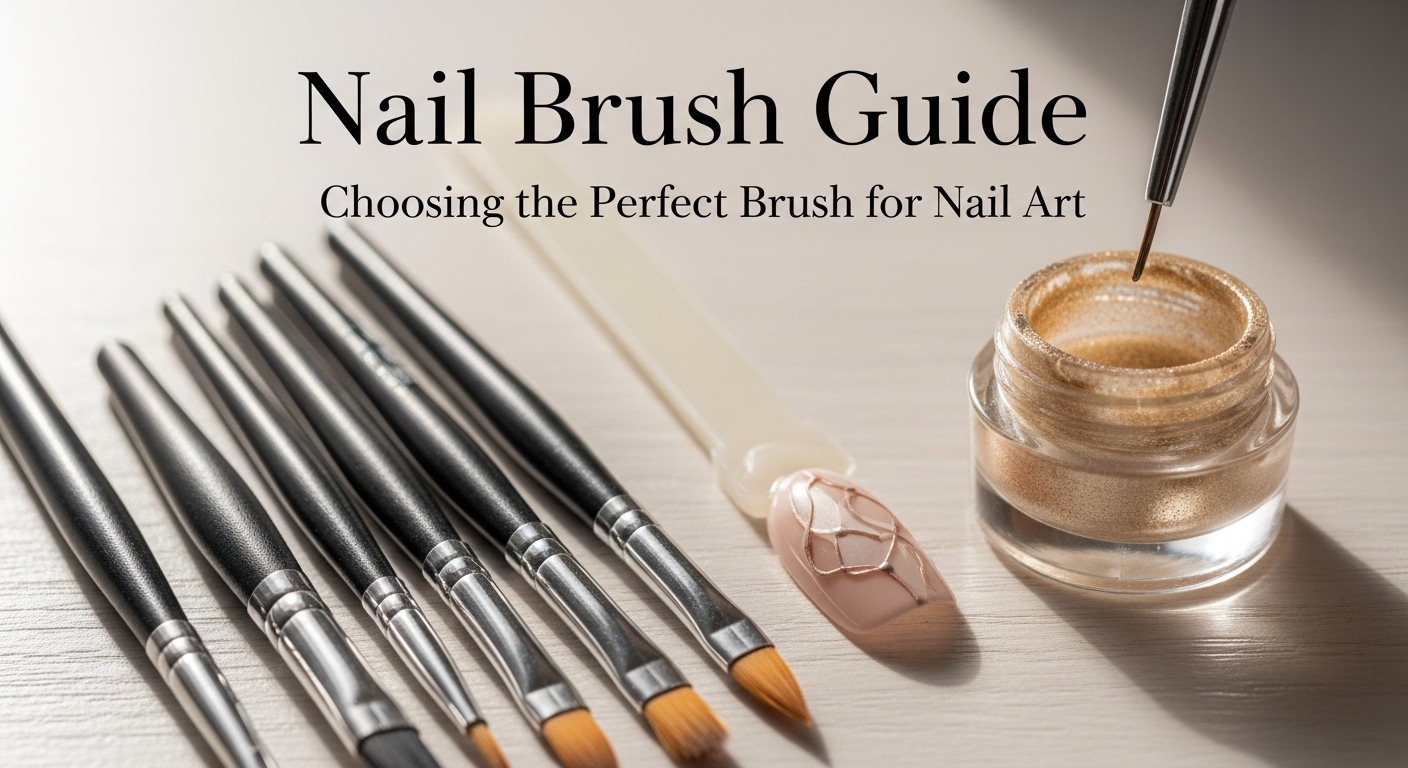

Choosing the perfect nail art brush depends on the design you want to create: use detail brushes (size 0 or 00) for tiny flowers and fine lines, flat brushes for filling in larger areas and one-stroke designs, striping brushes for long continuous lines, fan brushes for gradients and blending, and angled brushes for precise edges and French tips. Match your brush to your technique, and your nail art will look cleaner, take less time, and feel easier to create.
After years of doing nail art in South Africa, I’ve learned that the right brush doesn’t just make your work look better—it makes the whole process less frustrating.
Starting With What You’re Actually Creating
Before you think about brushes, think about the design:
Are you painting:
- Tiny detailed flowers?
- Bold geometric shapes?
- Flowing swirls and lines?
- Soft blended backgrounds?
- Sharp, clean edges?
Your design tells you which brush you need. Let me break down exactly which brush works for what.
Detail Brushes: For When Small Matters
What they look like: Super thin with a fine point. The bristles taper down to almost nothing. Usually marked as size 0, 00, or 000.
Perfect for these designs:
- Tiny flowers and leaves
- Delicate lace patterns
- Writing names or initials
- Small heart shapes
- Dots placed exactly where you want them
- Adding highlights to designs
- Fine outlines around shapes
How to know you need one: If you’re squinting while painting because the details are so small, you need a detail brush.
Using it right:
- Hold it like you’re writing with a pen
- Use very light pressure
- Keep the tip pointing straight down
- Load with less product than you think you need
- Rest your pinky on something stable
Price in SA: R30 to R150
I keep two detail brushes going—one for light colors and one for dark. Saves so much cleaning time during busy nail art sessions.
Flat Brushes: The Workhorses
What they look like: Wide, flat bristles cut straight across. Come in sizes from 2 to 12.
Perfect for these designs:
- One-stroke flower petals (those gorgeous petals made in a single stroke)
- Filling in large shapes
- Covering areas with color quickly
- Creating leafy designs
- Abstract art backgrounds
- Watercolor effects
How to know you need one: If you’re trying to fill in a shape and it’s taking forever with a tiny brush, grab a flat brush.
Choosing the right size:
- Size 2-4: Small details and tiny nails
- Size 6: Most popular for average nail art
- Size 8-10: Larger areas and long nails
- Size 12: Very large designs or toe nails
Using it right:
- Load both sides of the brush evenly
- Use smooth, confident strokes
- Don’t press too hard
- Keep the brush flat against the nail
Price in SA: R40 to R180
My size 6 flat brush is my most-used brush. It does about 60% of my nail art work.
Striping Brushes: For Lines That Flow
What they look like: Very long, thin bristles. Usually 1.5 to 3cm long. Much longer than a detail brush.
Perfect for these designs:
- Straight lines across nails
- French tip lines
- Swirls and curves
- Stems for flowers
- Geometric patterns with lines
- Plaid or checkered designs
- Tribal patterns
How to know you need one: If you’re trying to draw lines and they keep running out of paint halfway across, you need a striping brush.
Using it right:
- Load the brush fully with slightly thinned product
- Hold at a 45-degree angle
- Use your whole arm to move, not just your wrist
- Rest your pinky for stability
- Practice on paper first
The straight line trick: Rest both your hand and your client’s hand on the table. Move them together as one unit. Game changer for straight lines.
Price in SA: R35 to R120
Fan Brushes: The Blending Experts
What they look like: Bristles spread out in a fan shape. Can be flat or slightly rounded.
Perfect for these designs:
- Ombre or gradient effects
- Sunset and sunrise designs
- Soft, blended backgrounds
- Galaxy nails
- Watercolor looks
- Applying loose glitter for texture
- Creating cloudy skies
How to know you need one: If you’re trying to blend two colors and getting harsh lines instead of smooth transitions, grab a fan brush.
Using it right:
- Use a dabbing or stippling motion
- Don’t sweep or drag
- Work where colors meet
- Use light pressure
- Build up gradually
Price in SA: R30 to R100
Fan brushes transformed my ombre work. What used to take 10 minutes now takes 3.
Angled Brushes: For Precision Work
What they look like: Flat brush cut at an angle. The diagonal edge is the magic part.
Perfect for these designs:
- French tip smiles (that curved white tip)
- Sharp geometric shapes
- Creating perfect edges
- Chevron patterns
- Angled petals
- Half-moon designs at the cuticle
How to know you need one: If you’re struggling to get smooth curves or sharp angles, an angled brush will change your life.
Using it right:
- Let the angle do the work
- Follow the natural curve of the nail
- Use the thin edge for fine lines
- Use the wide edge for filling
- Keep turning the brush to match your design
Price in SA: R40 to R130
The angled brush makes French manicures so much easier. Perfect curves every single time.
Dotting Tools: Simple but Necessary
What they look like: Metal or plastic sticks with different sized balls on each end. Not technically brushes, but you need them.
Perfect for these designs:
- Polka dots (obviously)
- Flower centers
- Creating perfect circles
- Adding dimensional details
- Making ladybugs or other spotted creatures
- Marbling effects
How to know you need one: If you’re trying to make dots with a brush and they’re all wonky sizes, get dotting tools.
Using them right:
- Dip in polish or gel
- Touch gently to the nail
- Don’t drag
- Clean between each dot for perfect circles
- Different ball sizes = different dot sizes
Price in SA: R20 to R60 for a set
Dotting tools are cheap and make such a difference. Every nail artist should have at least one set.
Liner Brushes: The Middle Ground
What they look like: Thin and pointed but shorter than striping brushes. Usually about 1cm of bristles.
Perfect for these designs:
- Medium-length lines
- Outlining shapes
- Adding details to flowers
- Creating grass or hair textures
- Writing short words
How to know you need one: If detail brushes feel too small and striping brushes feel too long for what you’re doing, try a liner.
Using it right: Similar to detail brushes but you can use slightly more pressure because they’re less delicate.
Price in SA: R30 to R100
Honestly, if you have good detail and striping brushes, you might skip this one. But some nail artists love having the middle option.
Matching Bristle Type to Your Product
The product you use matters:
For regular nail polish:
- Natural or synthetic both work
- Synthetic is easier to clean
- Natural gives smoother flow
For gel polish:
- Synthetic works better
- Handles gel cleaner without damage
- Doesn’t absorb product like natural hair
For acrylic:
- Natural hair (Kolinsky) is best
- Holds and releases product perfectly
- Worth the extra money for acrylic work
For water-based paints:
- Natural hair works best
- Holds water better
- Creates smooth watercolor effects
Design-Specific Brush Recommendations
Let me walk you through popular designs and exactly which brushes you need:
Floral Nail Art
You need:
- Flat brush (size 6) for one-stroke petals
- Detail brush for small flowers and centers
- Striping brush for stems
- Dotting tool for flower centers
The process: Use the flat brush for main flowers, detail brush for baby’s breath and small blooms, striping brush for connecting stems, dotting tool to finish centers.
Geometric Designs
You need:
- Striping brush for straight lines
- Detail brush for corner points
- Flat brush (small) for filling shapes
- Angled brush for sharp angles
The process: Map out lines with striping brush, fill shapes with flat brush, clean up corners with detail brush, use angled brush for diagonal lines.
Ombre/Gradient Nails
You need:
- Flat brush to apply base colors
- Fan brush for blending
- Cleanup brush for edges
The process: Apply your colors roughly with flat brush, blend with fan brush using dabbing motion, clean edges with cleanup brush.
Abstract Art
You need:
- Flat brush in multiple sizes
- Detail brush for accents
- Fan brush for texture
- Striping brush for random lines
The process: Freedom to use whatever feels right. Abstract art is about experimenting with different brush strokes.
French Manicure
You need:
- Angled brush OR flat brush (size 4-6)
- Detail brush for fixing mistakes
- Cleanup brush
The process: Create the smile line with angled or flat brush, fix any wobbles with detail brush, clean edges with cleanup brush.
Brush Quality: What Actually Matters
Check these things:
The bristles:
- Should spring back when pressed
- No stray hairs sticking out
- Tips should align evenly
- No gaps in the brush
The ferrule (metal part):
- Should be tight on the handle
- No rattling or looseness
- Well-crimped with no gaps
The handle:
- Comfortable to hold
- Balanced weight
- Won’t roll off your table
Price vs quality:
- Under R20: Usually terrible
- R30-R80: Good for learning
- R80-R150: Solid daily-use quality
- R150+: Professional grade
You don’t need the most expensive brushes to create beautiful art. But you do need brushes that work properly.
Building Your Starter Collection
If you’re just getting into nail art, start here:
Month 1 – The basics (R150-R250):
- One detail brush (size 0)
- One flat brush (size 6)
- One striping brush
- One set of dotting tools
Month 2 – Add variety (R100-R150):
- Fan brush
- Angled brush
- Second detail brush
Month 3 – Expand options (R100-R200):
- Flat brush in different size
- Liner brush
- Another striping brush
This spreads the cost and lets you learn what you actually use before spending more.
Common Mistakes When Choosing Brushes
Mistake 1: Buying too many at once You’ll get overwhelmed and not learn each brush properly.
Mistake 2: Always using the same brush Different designs need different tools. Branch out.
Mistake 3: Choosing by price alone Super cheap brushes frustrate you. Super expensive ones don’t make you instantly better.
Mistake 4: Not trying before competitions Test new brushes on practice nails first, never on a paying client or competition.
Mistake 5: Expecting instant results Each brush has a learning curve. Give yourself time to get comfortable.
When Size Really Matters
Brush size affects everything:
Too big:
- Can’t do details
- Wastes product
- Hard to control
- Looks messy
Too small:
- Takes forever
- Uses too much product
- Tiring to use
- Creates texture issues
Just right:
- Feels comfortable
- Gives you control
- Works efficiently
- Creates smooth results
For nail art, you’re mostly using smaller brushes (sizes 0-8). Rarely do you need anything bigger than size 10.
Testing Brushes Before Buying
In stores that allow testing:
Feel the bristles: Press gently on your hand. They should spring back perfectly.
Check the tip: Point should be sharp and centered, not off to one side.
Look for shedding: Gently tug a few bristles. None should come out.
Test the balance: Hold like you’re working. Should feel comfortable and balanced.
Check the ferrule: Wiggle gently. Should be totally solid.
If you’re buying online, read reviews carefully. Look for comments about shedding, shape retention, and durability.
Brushes for Different Skill Levels
Complete beginner: Buy basic synthetic brushes. One detail, one flat, one striping, and dotting tools. Around R150 total.
Been doing nail art 3-6 months: Add a fan brush and angled brush. Try different sizes. Budget R200-R300.
Regular nail art (6+ months): Invest in better quality versions of brushes you use most. Keep cheap ones as backups. Budget R300-R500.
Professional or competitive: Buy premium brushes for your specialty. Individual high-quality pieces. Budget varies widely.
Caring for Your Art Brushes
Your brushes last longer when you:
After every use:
- Clean immediately (don’t let product dry)
- Reshape while damp
- Lay flat to dry
- Never stand upright while wet
Weekly:
- Deep clean with soap and water
- Check for damage
- Condition natural hair brushes
Monthly:
- Inspect for wear
- Replace damaged ones
- Clean storage case
A R80 brush that lasts two years is cheaper than R30 brushes you replace every month.
Where to Buy Quality Art Brushes in SA
Physical stores:
- Chinese beauty supply shops (good variety, test before buying)
- Nail supply stores in major cities
- Art supply stores (have nail art sections)
- Clicks/Dis-Chem (limited but convenient)
Online:
- Takealot (reliable delivery, easy returns)
- Bash (good prices)
- Beauty supply websites
- International sites (watch for customs)
My advice: Buy your first set in person so you can see and feel them. Order specific brushes online once you know what you like.
Understanding Brush Prices in South Africa
Why some brushes cost more:
Natural hair (Kolinsky):
- Comes from specific animals
- Holds shape perfectly
- Lasts longer
- Costs R80-R300+ per brush
Premium synthetic:
- Advanced bristle technology
- Mimics natural hair
- Very durable
- Costs R60-R150 per brush
Basic synthetic:
- Standard nylon
- Works fine for learning
- Good lifespan with care
- Costs R20-R60 per brush
You’re paying for materials, construction, and longevity. Sometimes the expensive brush is worth it. Sometimes it’s not.
Brushes That Grow With Your Skills
Some brushes work for beginners and pros:
Detail brush: Beginners use it for basic lines. Pros use it for micro-details. Same brush, different skill levels.
Flat brush: Beginners fill in shapes. Pros do one-stroke art. Grows with you.
Striping brush: Beginners make wavy lines. Pros create perfect straight lines and complex patterns.
Buy good versions of these three. They’ll serve you for years as your skills improve.
Quick Reference Chart
Want to paint: Tiny details → Use: Detail brush (000-0) Want to paint: Fill large areas → Use: Flat brush (6-8) Want to paint: Long lines → Use: Striping brush Want to paint: Blended colors → Use: Fan brush Want to paint: Curved edges → Use: Angled brush Want to paint: Perfect circles → Use: Dotting tools Want to paint: Medium details → Use: Liner brush
Save this list on your phone. Reference it when planning designs.
The Brushes Professional Nail Artists Actually Use Most
I asked ten professional nail techs in Johannesburg what’s in their everyday kit:
Everyone had:
- At least two detail brushes
- One flat brush (size 6 or 8)
- One striping brush
- Dotting tools
Most had:
- Fan brush
- Angled brush
- Cleanup brush
Some had:
- Liner brushes
- Multiple flat brush sizes
- Specialty brushes for 3D work
The basics cover 90% of client requests. Specialty brushes are for specific techniques or designs.
Making Your Choice
Think about:
What designs do you love creating? Your favorite styles tell you which brushes matter most.
What do clients request most? Stock brushes for your popular designs.
What’s your budget right now? Start small and build up. Quality matters more than quantity.
What’s your skill level? Beginners need basics. Advanced artists need specialty tools.
What products do you use? Match bristle type to your gel, acrylic, or polish work.
Your answers point you to the right brushes for YOUR nail art journey.
The perfect brush for nail art is the one that makes YOUR designs easier and more beautiful. Start with the basics, practice with each one, and add specialty brushes as you discover new techniques you love. The right tools don’t make you an artist overnight, but they do make the path easier and more enjoyable.
Now pick up that brush and create something beautiful. Your nails are waiting.